

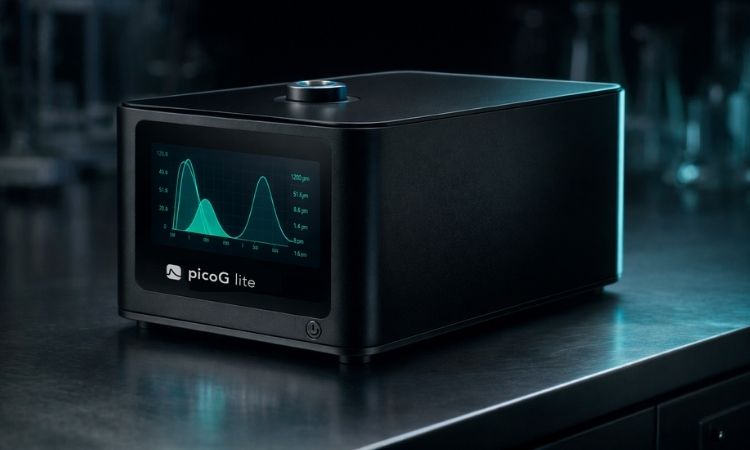
femtoG launches picoG-lite analyzer for coarse-particle characterization in recovered carbon black

The picoG-lite powder analyzer is a new advanced instrument that reliably detects oversized particles in recovered carbon black (rCB) by measuring the mass of single particles in picograms (pg; 10−12 g). The instrument is positioned as a lower-cost alternative to conventional laser particle-size analyzers and can characterize pelletized samples as well. Accurate analysis of the product fineness can cut processing costs by 15–30 €/t for regular rCB and by more than 100 €/t for ultra-fine grades.
The measurement concept relies on shooting single particles onto a piezo crystal. Each particle that bounces off the piezo crystal generates a voltage proportional to its mass. | Image by https://femtog.com/picoG-rCB/.
The particle size of rCB, in particular the content of non-dispersible, oversized particles, is a major quality parameter. Soon, an ASTM standard (with current work document WK87480) will define how to measure the D97 by laser diffraction, which will improve the reproducibility of rCB fineness determination. However, what no standard can remove are the systematic biases of the method itself. They arise from the complex composition and structure of rCB particles, and from the fact that every instrument manufacturer uses different optical cells and data processing algorithms.
This is no flaw in the standard: its purpose is not to measure the true particle size, but to give buyers and sellers a common frame of reference for trading rCB. The bias, however, stays. To safely meet a customer specification of, say, D97 ≤ 10 µm, a producer has to mill their rCB further down to 8 or 9 µm, so that every customer (using whichever laser particle sizer sits in their incoming goods inspection) measures a D97 below 10 µm. The required over-milling consumes extra electricity, raises CO2 emissions and cuts milling throughput. One could call it an uncertainty tax, levied not by any authority, but by physics.
“The simple truth is that rCB particles are neither homogeneous nor round. There will always be a systematic error in the D97 measurement, which cannot be removed by an SOP,” says Dr. Franz Friebel, co-founder and CTO at femtoG. “As long as different laser particle sizers give different results, some rCB producers have to pay the uncertainty tax.”
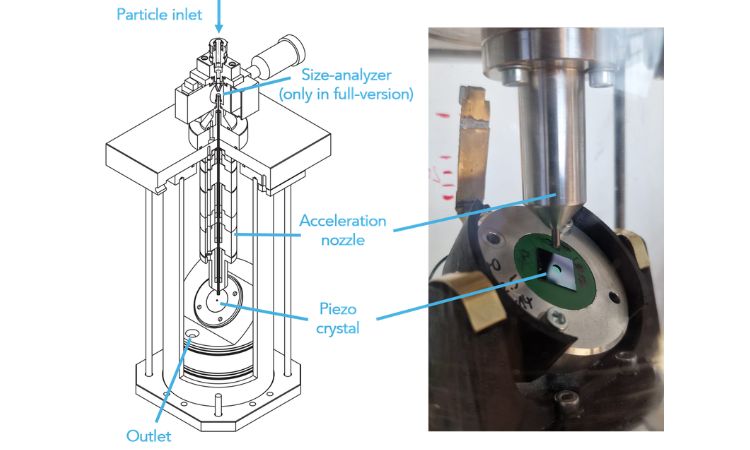
The measurement concept relies on shooting single particles onto a piezo crystal. Each particle that bounces off the piezo crystal generates a voltage proportional to its mass. | Image by https://femtog.com/picoG-rCB/.
picoG-lite sidesteps the problem by measuring a quantity that leaves no room for interpretation: the mass of every single particle. Unlike any diameter measurement, mass requires no assumptions about particle shape, composition or refractive index.
The measured results correlate with the D97 from laser diffraction and can be aligned with the rCB size classes proposed within the upcoming ASTM D36 standard (WK71958).
A single measurement takes only 2-4 minutes during which more than 10,000 individual particles are detected. And because the instrument counts each particle one by one, the few pellet fragments in a depelletized sample no longer dominate the result, making routine inspection of pelletized rCB practical for the first time.
The picoG-lite benchtop analyzer is in the final development stage and can be preordered now. rCB producers interested in integrating picoG-lite directly into their production line for continuous rCB quality monitoring are invited to get in touch. White papers and technical details are available in the downloads section at https://femtog.com/picoG-rCB/. Inquiries can be directed to rCB-analyzer@femtoG.com.
About femtoG
femtoG AG is a spin-off of ETH Zürich specializing in particle characterization. Its mission is to establish the particle mass as the universal metric for particle size.
femtoG develops and sells particle and powder analyzers for any material in the range of 5 nm to 100 µm. Beyond routine analyses, femtoG conducts customized research projects for material producers, such as quantifying nanoparticles in pigments, protecting patent claims with new parameters like aggregate fractality, or predicting the lung deposition of pyrogenic metal oxides.
Weibold is an international consulting company specializing exclusively in end-of-life tire recycling and pyrolysis. Since 1999, we have helped companies grow and build profitable businesses.